

AI Development & Research Intelligence
Building an AI-Powered Research Intelligence Platform for Scientific Data Discovery
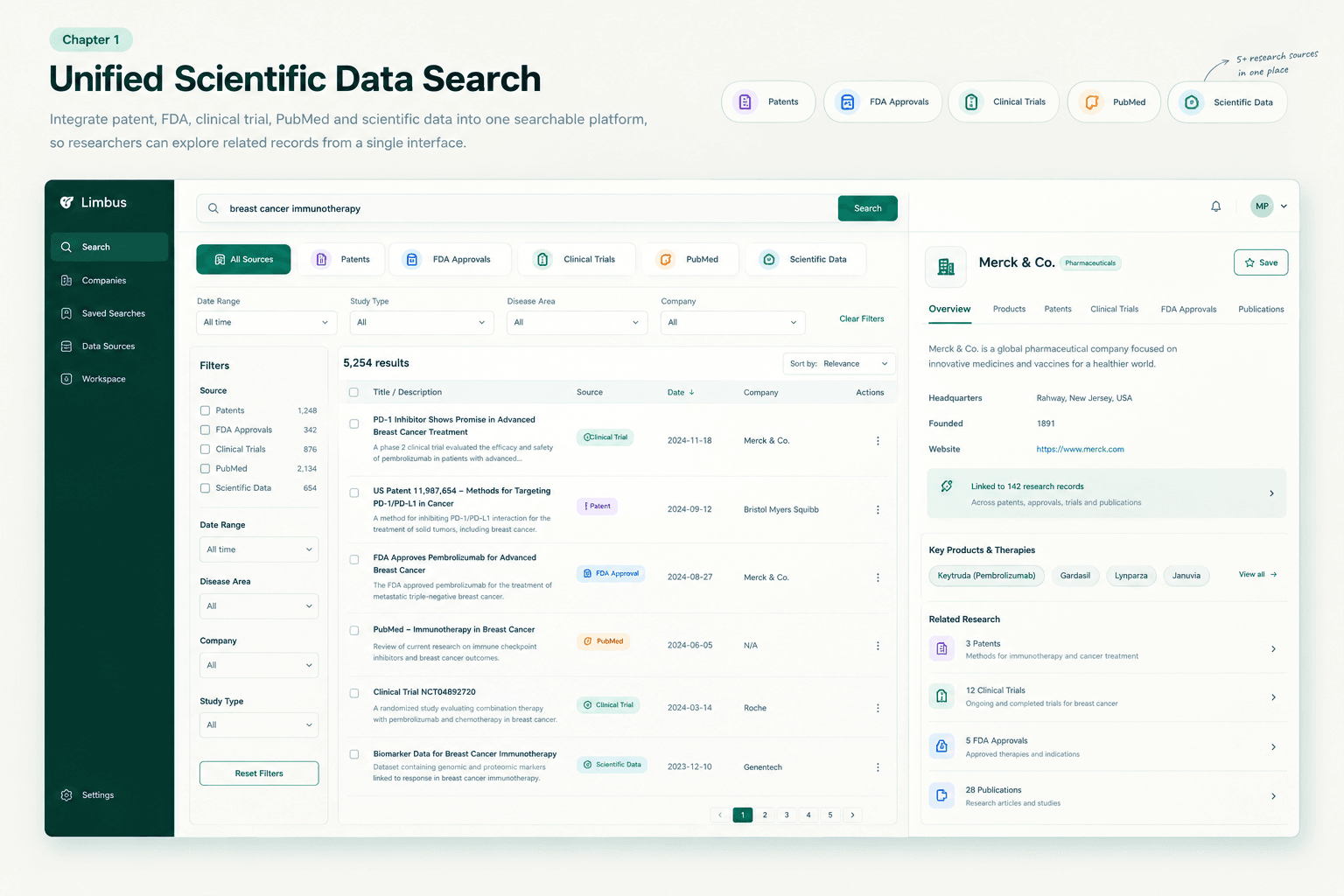
LOAM developed an AI-powered research intelligence platform that unifies patent records, FDA approvals, clinical trials, PubMed publications, and scientific datasets into one searchable system. With AI-driven semantic search, automated data integration, and unified company profiles, the platform helps researchers discover relevant scientific information across multiple sources.
01 - About Client
About Our Partner
Our partner in this project is DTC Apparel Brand, a retail-ecommerce company building at scale.
Company Overview
Direct-to-consumer retail, $40M+ annual revenue, national fulfillment
Project Timeline
6 months
Engagement Type
Platform rebuild
Discover the challenge and how we solved it
Continue →02 - Project Overview
AI Research Platform Development: Project Overview
LOAM built an AI-powered research intelligence platform that unifies patent, FDA, clinical trial, PubMed, and scientific data with semantic search and automated data integration for faster research discovery.
Scientific and pharmaceutical research often requires information from multiple sources, including patent records, FDA approvals, clinical trials, PubMed publications, and scientific datasets. Searching these disconnected sources separately can make it difficult to build a complete picture of a company, product, or research area. The project aimed to bring these diverse records into a unified research intelligence platform.
LOAM built a custom web application with a React frontend, Django backend, and MongoDB database. The platform integrates multiple public research data sources and organizes related records into company profiles. Researchers can search information, review results, export data as CSV files, save searches, and manage their accounts through a single interface.
Key Metrics
5 Integrated Sources
Research Data Sources
Semantic & Full-Text Search
AI Search Capability
Automated ETL Pipelines Copy labelCopy value
Data Processing
React, Django & MongoDB Copy labelCopy value
Application Technology
03 - Challenge & Goals
Researchers needed a unified way to search fragmented scientific, patent, FDA, and clinical trial data across multiple sources.
Understanding both the business and technical landscape
Business & Operations
Separate databases and inconsistent company names made research discovery and company-level analysis more complex.
Technical Constraints
The platform needed to integrate heterogeneous data, support AI-powered semantic search, and keep records updated through automated ETL pipelines.
Success Goals
Unified Scientific Data Search
Integrate patent, FDA, clinical trial, PubMed, and scientific data into one searchable research intelligence platform.
AI-Powered Semantic Search
Implement AI-driven semantic search to help researchers find relevant scientific records based on meaning, not just exact keywords.
Automated Data Integration & Company Matching
Automate data collection, cleaning, and updates while matching inconsistent company names to unified company profiles.
04 - Discovery & Strategy
Engineering Discovery
We assessed fragmented research data sources, search requirements, and data quality challenges to define a unified AI-powered research intelligence platform.
Research Data Source Analysis
Finding
Patent, FDA, clinical trial, PubMed, and scientific datasets were spread across separate sources, making unified research discovery difficult.
Decision
Integrate the five research data categories into a centralized platform with a unified search interface.
Outcome
A clear foundation for cross-source scientific data discovery and company-level research.
Search Requirements Analysis
Finding
Keyword-only search can miss relevant scientific records when researchers use different terminology to describe similar concepts.
Decision
Implement AI-powered semantic search using embeddings, with full-text search as a fallback.
Outcome
Search designed to retrieve relevant records by meaning as well as exact terms.
Data Quality & Company Matching
Finding
Inconsistent company names and unlinked records can fragment research information across data sources.
Decision
Inconsistent company names and unlinked records can fragment research information across data sources.
Outcome
Use AI-assisted entity resolution and administrative tools to group company variants and link records to unified profiles.
Data Integration & Refresh
Finding
Research records from multiple public sources require cleaning, normalization, and ongoing updates before they can be searched consistently.
Decision
Build scheduled ETL pipelines to collect, clean, normalize, and refresh scientific data.
Outcome
A repeatable data ingestion process supporting the research intelligence platform.
Platform & Administration Planning
Finding
The platform needed researcher-facing search features alongside controls for managing users, records, company profiles, and data ingestion.
Decision
Develop a React frontend, Django backend, and MongoDB data layer with role-based permissions and dedicated administrative tools.
Outcome
An integrated web application supporting research discovery, data management, and administration.
05 - System Architecture
AI Research Platform Architecture
LOAM designed a layered architecture combining a React frontend, Django backend, MongoDB database, automated ETL pipelines, and AI-powered semantic search to unify scientific research data and support scalable discovery.
Research & Search Interface
Built a React frontend enabling researchers to search scientific records, explore unified company profiles, export CSV data, save searches, and manage their accounts.
Backend Services & APIs
Implemented Django backend services for authentication, role-based permissions, REST APIs, user activity tracking, and research data access.
Scientific Data Management
Used MongoDB to store flexible research records from heterogeneous sources, supporting company profiles, scientific publications, patent information, regulatory approvals, and clinical trial data.
AI-Powered Semantic Search
Implemented AI embedding-based semantic search with full-text search fallback, helping researchers discover conceptually relevant scientific records. AI-assisted entity resolution groups inconsistent company names into unified profiles.
Data Integration & ETL
Built scheduled ETL pipelines to collect, clean, normalize, and refresh data from public research sources, supporting consistent records across the platform.
System Design Philosophy
Each layer serves a specific purpose and can be scaled or updated independently. The separation of concerns ensures that critical systems evolve cleanly without forcing risky changes across the full platform at once.
06 - What We Built
Platform Architecture
LOAM built a custom AI-powered research intelligence platform with unified scientific data search, semantic discovery, automated data pipelines, and company-level research profiles. The platform combines researcher-facing search tools, AI-powered discovery, flexible data storage, and administrative controls to simplify access to fragmented scientific information.
Each system is designed to operate independently while contributing to a unified platform experience.
Unified Scientific Data Search
System 01
AI-Powered Semantic Search
System 02
Automated Scientific Data Integration
System 03
AI-Assisted Company Profile Matching
System 04
Unified Scientific Data Search
Integrated patent, FDA approval, clinical trial, PubMed, and scientific data into one searchable platform, enabling researchers to explore related records from a single interface.
- ✓Cross-source research search
- ✓CSV data exports
- ✓Unified company profiles
AI-Powered Semantic Search
Implemented AI embeddings for meaning-based scientific search, supported by full-text search as a fallback to help users discover relevant records beyond exact keyword matches.
- ✓Semantic search using AI embeddings
- ✓Full-text search fallback
- ✓- Relevant scientific record discovery
- ✓Fraud detection integration

Automated Scientific Data Integration
Developed scheduled ETL pipelines to collect, clean, normalize, and refresh public research data for consistent searching across multiple scientific sources.
- ✓Automated data ingestion
- ✓Data cleaning and normalization
- ✓Scheduled data refreshes

AI-Assisted Company Profile Matching
Implemented AI-assisted entity resolution to group inconsistent company name variants into unified profiles and help connect research records to the relevant companies.
- ✓Company name matching
- ✓Unified company profiles
- ✓Research record linking

07 - Delivery & Engineering
How We Delivered
Discover
Analyzed research data sources, search requirements, company matching challenges, and data integration needs.
Output: Research platform requirements and data integration plan.
Design
Designed the platform architecture for the React frontend, Django backend, MongoDB database, semantic search, and automated ETL pipelines.
Output: Technical architecture and research data workflow design.
Build
Developed unified scientific search, company profiles, AI-powered semantic search, REST APIs, scheduled data pipelines, and administrative management tools.
Output: Integrated research intelligence web application with AI search and data management capabilities.
Validate
Validated cross-source research search, data normalization, company record matching, role-based permissions, and CSV export functionality.
Output: Validated research workflows and core platform functionality.
Deploy
Prepared the integrated platform workflows for researcher access, automated research data ingestion, and administrative operations.
Output: Research intelligence platform prepared for use with integrated search and data management workflows.
Strategic Decisions
Key Engineering Decisions
Challenge
Keyword-only search can miss relevant scientific records when researchers use different terms to describe similar concepts.
Decision
Implemented AI embedding-based semantic search with full-text search as a fallback to support meaning-based scientific data discovery.
Outcome
Researchers can search for conceptually relevant records beyond exact keyword matches.
Challenge
Patent, FDA, clinical trial, PubMed, and scientific records have different structures and data fields.
Decision
Used MongoDB to store heterogeneous research records in a flexible data model, supported by Django APIs for controlled data access.
Outcome
A unified data layer supports research records from multiple scientific sources.
Challenge
Inconsistent company names can fragment related patents, approvals, trials, and publications across separate records.
Decision
Implemented AI-assisted entity resolution to group company-name variants into canonical company profiles, with administrative tools for record linking and company merging.
Outcome
Related scientific records can be organized under unified company profiles for easier research.
08 - Impact & Testimonial
The Results
Primary Business Impact
3x
Peak traffic capacity increase
Business Metrics
$220K
Prevented via 99.9% uptime on promo days
45%
Faster marketing time-to-publish
0
Overselling incidents since launch
Engineering Metrics
1.8s
Page load time (p95)
99.9%
Uptime on promo days
15x
Designed peak traffic capacity
Before & After
Promo-Day Uptime
Before
Partial outages on 2 of 3 events
After
99.9% uptime on all events
Page Load Time
Before
5-8 seconds at peak
After
1.8 seconds (p95)
Time-to-Publish
Before
2-3 days for catalog changes
After
1-2 hours via CMS API
“Before Loam, every promo day was a disaster we braced ourselves for. Now it's just another day with higher traffic. The headless architecture freed our marketing team from waiting on engineering for every change, and the checkout service is rock-solid even at 10x normal traffic.”
Marcus Thompson
VP of Product
DTC Apparel Brand